ACADEMIC RESEARCH PROJECT · 2026
Simulating H₂’s Ground-State Energy
A Variational Quantum Eigensolver study of the hydrogen molecule: mapping H₂ to a four-qubit Hamiltonian, optimizing a parameterized circuit, and comparing its energy estimate with a classical reference.
- Molecule
- H₂ · 0.735 Å
- Circuit
- 4 qubits · 24 parameters
- Execution
- Qiskit statevector simulator
- Final estimate
- −1.11712 Ha
Overview
The project asks whether a compact variational circuit can recover the ground-state energy of H₂ at a fixed bond length. It is a useful end-to-end exercise in translating a chemistry problem into a quantum-circuit optimization loop, while keeping the scope deliberately narrow.
We used the equilibrium bond length of 0.735 Å and the STO-3G basis. This is a simulator study of one molecule and one geometry, not a run on quantum hardware or evidence of quantum advantage.
Method
The electronic Hamiltonian was represented by 15 Pauli terms after a Jordan–Wigner mapping. Its coefficients were entered manually because PySCF could not be installed in the project environment; that choice made the calculation runnable, but left Hamiltonian generation outside the automated pipeline.
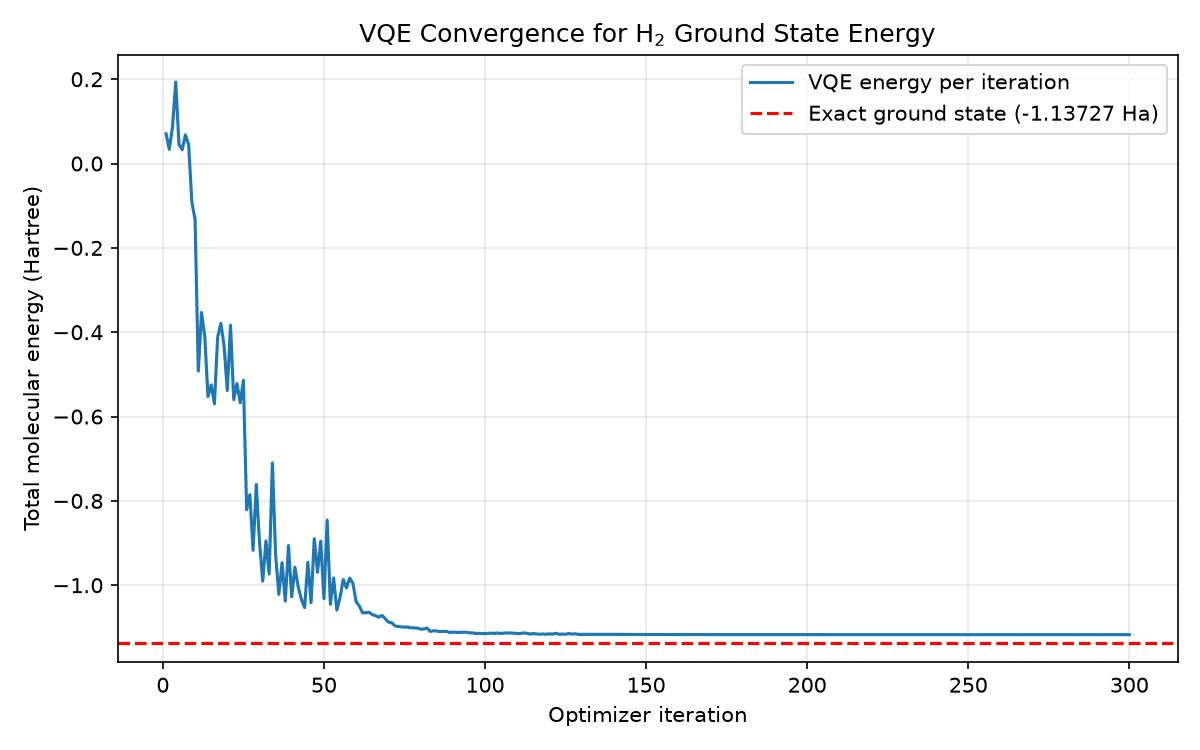
A hardware-efficient ansatz used parameterized RY and RZ rotations with a linear chain of CZ entanglers. COBYLA adjusted its 24 parameters for up to 300 iterations, and Qiskit’s noise-free StatevectorEstimator evaluated each energy.
H₂ geometry
0.735 Å · STO-3G
Pauli model
15 terms · Jordan–Wigner
Trial state
4 qubits · RY/RZ + CZ
Optimize
COBYLA · ≤300 iterations
Evaluate
Statevector · energy in Ha
Results
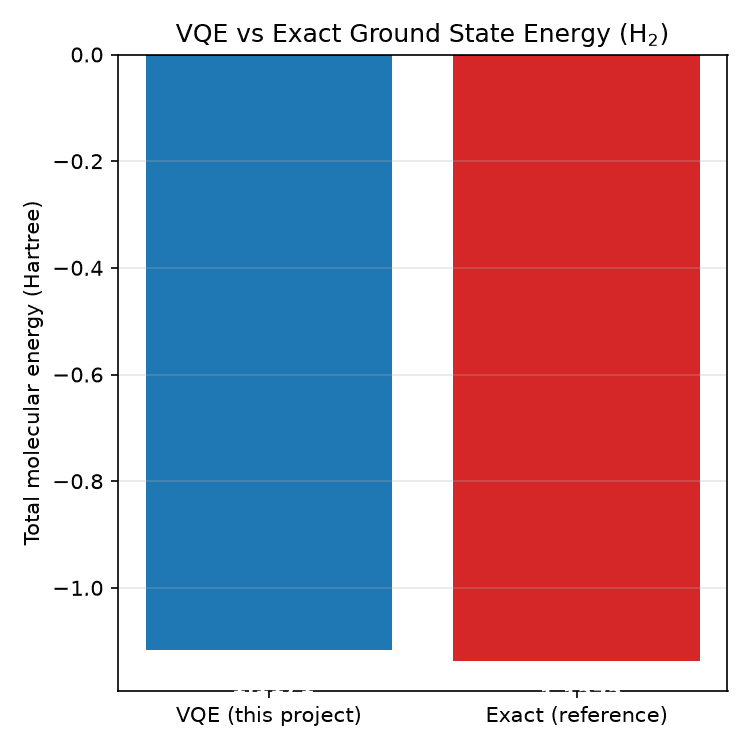
The energy decreased quickly during early optimization, then flattened above the classical reference. The optimizer found a lower-energy state within the chosen ansatz, but the remaining gap shows that convergence alone is not the same as an accurate chemistry result.
- VQE estimate
- Noise-free statevector simulation
- Classical reference
- Reference used in the report
- Absolute error
- Difference from the reference
- Chemical accuracy
- Target threshold; not reached
Limitations & Next Steps
The ansatz may be too restrictive
Compare the hardware-efficient circuit with chemistry-informed options such as UCCSD.
The Hamiltonian path is partly manual
Automate molecular integrals and qubit mapping so geometry changes can be reproduced reliably.
The evaluation is idealized
Test optimizer choices and budgets, then add shot noise and hardware-inspired noise models.
Only one geometry was studied
Scan bond lengths to see whether the approach tracks the energy curve, not just one point.
The useful outcome is the complete experiment and a quantified miss: the circuit reaches −1.11712 Ha, about 0.02015 Ha above the reference. That gives the next iteration a concrete target: improve the state preparation and make the chemistry-to-circuit workflow reproducible before drawing broader conclusions.